Sunday, August 14, 2011

Israel: Negev Adventures: Goats, Wines, & Crocodiles!

As readers of this blog know, Dan and I spent a glorious month in Israel thanks to his winning us tickets from the American Friends of Ben Gurion University of the Negev. After days in Tel Aviv, Beersheva (getting to visit the Ben Gurion University of the Negev  campus & research facility), and then our stay at the Dead Sea, and exploration of Masada, our next two days were a grand, "foodie-winey" adventure in the Negev Desert, but before we left the Dead Sea, I HAD to have one more "dip and float" in the morning! Then Dan and I had our "tourist photo" on the Big Blue Bull in front of the Crowne Plaza Dead Sea, and breakfast at the Ein Bokek McDonald's, just to say we did!
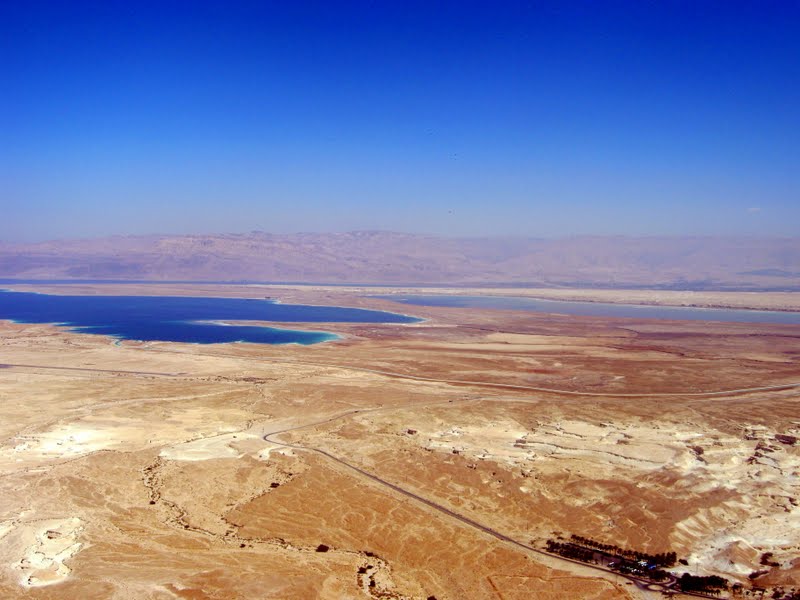
View of the Dead Sea from our Crowne Plaza room...

D & E on the Big Blue Bull...

Yes, you can do Mickey D's at the Dead Sea!

Archaeological sites in the Negev...


CrocoLoco!
 Driving thru the Negev, we found a truly unique place: The CrocoLoco Crocodile Farm at Ein Hatzeva Junction! CrocoLoco is a unique desert farm raising the African Nile crocodiles that were once indigenous to the area, and helping protect the species from extinction by providing buyers in the leather industry with a sustainable alternative to skins acquired through illegal hunting. We not only got to learn about them, Elisse got to play "pat-the-croco"!

CrocoLoco!


CrocoLoco!

Up close & personal!


Elisse, making nice-nice with a baby crocodile!


At an archaeological site in the Negev


Train crossing in the desert...

The Negev...

Petrified Forest in the Negev


Petrified Forest
 Heading for Naot Farm, a gourmet goat cheese farm in the Negev, we stopped along the way at the archaeological digs we passed, and to see the ancient Petrified Forest.  Seeking uniquely Israeli things to do and places to stay, so that Dan (as well as I) could experience as much "real" Israel as possible and meet some great people, I arranged for us to spend a night at Naot Farm, run by the charming and welcoming Nachimov family, where we got to pet the baby goats, see how their gourmet goat cheeses are made, stay in lovely Cabin 1 (you can see it on their website!), and enjoy a truly splendid breakfast that included a selection of their delicious goats milk cheeses and milk, as well as freshly baked breads, salads & spreads, honey (from a local Negev farm, which we bought), eggs, and fresh-squeezed orange juice! (I loved the handmade soaps in our guest room!) We bought food & Israeli wine at the nearby gas station store (LOL - if only US gas stations sold fine wine & made cappuchino!), and made ourselves a pasta dinner that night in our romantic little cabin, sitting outside on our desert porch with our wine, enjoying the cool desert night and a sky sprinkled with a billion stars...

Milking goats at Naot Farm


Dan & Elisse, petting goats at Naot Farm!


L'Chiam!


A desert night...


Chef Dan, making dinner in the desert!


A cappuccino & gourmet goat milk for breakfast!

Totally scrumptious breakfast, delivered to our cabin...goat cheeses, fresh OJ, breads, & salads...

Baby goats!


Tiny kids, all snuggled up!


Gourmet goat cheese...

Making cheeses by hand...

Our cabin in the desert...

I booked us stays at both this lovely, rustic farm bed-and-breakfast, and the Carmey Avdat Winery, where we spent the next night, so we got to experience a bit of the "off the beaten path" Israel I love so much. Once-upon-a-time (not so long ago!) Israel was "famous" for having one or two truly mediocre wines that were tooth-rottingly sweet- not any more! Israel now has more than 300 wineries producing internationally-acclaimed, award-winning wines, some selling for upwards of $300 a bottle, and wineries literally crisscross the country from the Negev desert to the snow-capped mountains of the Golan Heights! In a tiny country the size of New Jersey this is nothing short of amazing! The best part is that Israeli restaurants and bars feature and promote Israeli wines, so although Dan and I only had a chance to visit a few wineries throughout our month in Israel, we enjoyed a wide variety of Israeli wines throughout our stay. We tasted and bought wine at each winery we visited, and were able to bring at least one bottle of wine from each back to the Elkhorn Inn to share and enjoy with friends! (And  Elisse knows how to pack a suitcase! LOL)
On the way to Carmey Avdat, for example, we stopped at the Rota Winery, in the Negev Heights, which was suggested to us by Ben Brewer of Israel Food Tours , and we weren't disappointed! To stand out in the middle of a desert vineyard in the warmth of a spring morning, tasting a selection of fine wines with Erez Rota, the winemaker, surrounded by his sculptures, was one of The most delightful experiences we had on this trip!

Erez Rota & Dan, in the vineyards...


Desert sculpture by Erez Rota


Erez Rota, creating a desert wine-tasting...


A wine tasting in the desert at Rota Winery

We bought several Rota wines, including his excellent 2008 Cabernet Sauvignon. A boutique winery, Rota is now producing more than 10,000 bottles a year, for export as well as domestic consumption, they are now certified Kosher, and his wines are, deservedly, doing well in international competitions!

Following the little "grape" signs along the highways, our next stop on the Negev Wine Route was the Nahal Boker Winery, where we ran into friends from Ben Gurion University of the Negev, who were showing Israel's wineries off to a bevy of journalists! We enjoyed a wine tasting with Moshe Zohar, who founded the winery together with his wife Hilda, and bought a bottle of his wine, as well as local olive oil, in the lovely shop/dining room that overlooks a Negev vista "what to die for"!


Moshe Zohar, founder of Nahal Boker Winery

Nahal Boker vineyards


Sculpture in the Negev mountains...

We arrived at our destination, Carmey Avdat Vineyards, in the late afternoon. Founded by Hanna and Eyal Izrael in the Negev Highlands, Carmey Avdat is a small, family-run winery producing approximately 6000 bottles of wine a year, based on Merlot and Cabernet Sauvignon, and uniquely located on the terraces of a 1500-year old agricultural settlement on the ancient Spice Route! The vineyard is irrigated with water from the flash-floods that occur each winter in the Negev mountains, and the cold winters and dry summers have provided an ideal climate for growing wine grapes since ancient times. We had a lovely, romantic cabin, and a delicious dinner of veal with mushrooms, Vietnam-style spring rolls, zucchini with mint, fresh lemonade, and sweets was delivered to our door! We enjoyed it, together with a bottle of Israeli wine, on the little outdoor table overlooking their beautifully landscaped farm, and had a totally perfect evening! In the morning, after our delivered-to-the-door gourmet breakfast, we got to see the Izraels bottling their Port wine, and then had a wine-tasting with Eyal Izrael of their various vintages, buying bottles of our faves: their 2007 Merlot and Cabernet Sauvignon, and their truly fine Port, to take with us! (From Wines Israel: Carmey Avdat, Merlot, 2007: Dark garnet with a hint of adobe, medium- to full-bodied with good concentration and extraction, its tannins and spicy wood now integrated, opens to show appealing blackberry, black cherry, purple plums and chocolate, all lingering nicely on the palate. Drink now. Score 87. Carmey Avdat, Cabernet Sauvignon, 2007: Dark garnet, medium- to full-bodied, with soft tannins and notes of spicy wood. On the nose and palate blackcurrant, blackberry and cherry fruits, those on a background of earthy minerals and a hint of mint on the finish. Drink now. Score 85).
Carmey Avdat Vineyards

Dan, in front of our cabin at Carmey Avdat


Dan & Eyal Izrael, at our wine tasting

Port, being bottled

Dan, at Carmey Avdat


Spring!


Elisse, in our cabin's hammock!


Elisse, in the ancient/modern Carmey Avdat vineyards
Next: Drinking Israeli wine in a 2000 year old wine press, & Israel's answer to the Grand Canyon!

Tuesday, August 2, 2011

Israel: Masada!

An absolute must-do during our month in Israel in March-April (made possible by the American Friends of Ben Gurion University of the Negev) was to go to Masada. The first time I was at Masada was in 1973 with my father, and I wanted to see the new archaeological excavations and share this incredible, profound historical site with Dan.  In addition to the Israel Nature & Parks Authority website I linked above, Chabad has great website pages on Masada, as does the Jewish Virtual Library. Masada has been a UNESCO World Heritage site since 2001; an enduring symbol of the fight for Jewish freedom, it is a famous site for IDF swearing-in ceremonies; "Masada shall not fall again" is The succinct expression of Israeli sovereignty.
Dan, going up to Masada in the new cable car

Cable car up to Masada...


Dan, at Masada

Dan, at Masada

Elisse, with frescos, Masada


The Dead Sea, from a window at Masada...

The Dead Sea, from Masada

Masada


Frescos, at Masada


Looking down, from Masada


Dan, with the model of Masada

Heated bathhouse floor, Masada

The path up to Masada

Elisse, in the Synagogue, Masada

Dovecot, Masada

Elisse, with stone ammo, Masada

Ongoing mosaic restoration, Masada

Mosaic floor, Masada

The Dead Sea, from Masada

The Dead Sea and surrounding desert, from Masada


Built by King Herod, the Roman-backed Governor of Israel, in the 1st century BCE, Masada was both an elaborate mountain top fortress with palaces, bathhouses, storerooms, and cisterns, and Herod's fairly fabulous vacation home, built 1,200+ feet above the surrounding desert and looking out over the Dead Sea.
In 66 CE, Masada became a refuge for Jewish zealots, led by Elazar ben Ya'ir, who were resisting Roman rule. Following the Roman conquest of Jerusalem and the destruction of the Second Temple in 69 CE, more Jews joined the group and resisted Roman efforts to dislodge them, living on food that Herod had stored, and water from the cisterns. In 72 C.E., Roman governor Flavius Silva decided to do away with this outpost of resistance once and for all, and the 15,000 people of the Roman camp, including the 10th Roman Legion and Jewish prisoners-of-war, prepared for a long siege against the 1,000 men, women, and children up on the mountain. After failing to breach the wall on the east side, they built an assault ramp against the western side, using thousands of tons of stones and earth. Using a battering ram, they broke the stone wall of the fortress. The defenders had built another wall that the Romans could not break with the battering ram because it was soft and yielding, so the Romans destroyed it with fire, and planned to enter the next day. That night, Eleazar gathered the zealots and spoke to them; they decided to kill themselves rather than fall into the hands of Romans. Each man killed his wife and children, then the men drew lots and killed each other until the last man set fire to everything and killed himself. In the morning, the Romans entered the fortress and found only dead bodies. Two women and five children survived the mass suicide by hiding in a cistern, which is how the story came to be known to the historian Josephus Flavius, nee Joseph ben Matityahu. Born into a priestly family, he was a young leader at the outbreak of the Great Jewish Rebellion against Rome (66 CE) when he was appointed governor of Galilee. Managing to survive the suicide pact of the last defenders of Jodfat, he surrendered to Vespasian (who was then proclaimed emperor); calling himself Josephus Flavius, he became a Roman citizen and a successful historian, and remains the significant source of information about Masada. Since the site of Masada was identified in 1838, discoveries and excavations have occurred regularly; Masada National Park was opened in 1966, and the Israel Nature and Parks Authority continues to carry out conservation and restoration activities, as well as ongoing excavations. You can walk up the famous "snake path" to Masada or take the cable car; given the heat and our "gotta see everything!" time constraints, Dan & I took the cable car!
It was fascinating to see the ongoing archaeological and restoration work, including the extraordinary frescoes and mosaics, as well as the Roman military camps below Masada which I hadn't seen back in 1973. We did a self-guided tour with headphones and found it excellent; we did several such tours throughout our trip through Israel and got a great deal out of them. Allowing you to wander and take it all in at your own pace, these tours allow you to understand at least a bit of what you're looking at; archaeological sites, especially complex ones, can often look like "just another pile of rocks" without a guide or a book!

Next: More Negev adventures: gourmet goat cheese, desert vineyards, and crocodiles!

Wednesday, July 27, 2011

Israel! The Dead Sea & The Negev!

(Note: my lapse in blogging has been due to an epic computer crash which disappeared  over 10 years worth of our business, government, legal, and personal emails, files, and documents. We had paid and relied on Carbonite to back us up, but they lied. They took our money, repeatedly stated our computer was backed up, but didn't do it, and when we and our tech attempted to work with them to recover our documents and files, told us to lump it and hung up on him twice. In our opinion they are criminals, and we are advising everyone we know: DO NOT USE CARBONITE).

As readers of this blog know, Dan & I spent a glorious month in Israel in March and April of this year thanks to Dan rather miraculously winning us tickets from American Associates of Ben Gurion University of the Negev!  My first Israel blog posts were about our days in Tel Aviv, our excellent "foodie" cooking and architecture tour of Tel Aviv and Jaffo with Israel Food Tours, our Israel Railways train travel to Beersheva and our day at Ben Gurion University. From Beersheva, we drove our rental car thru the glorious mountains of the Negev desert down to Ein Bokek on the Dead Sea, basically my favorite place in the world! I have Psoriasis, and 30 days at the Dead Sea clears it totally (as well as healing rheumatoid arthritis and other ailments); when I lived in Israel I tried to spend a month there every year. When I was a soldier in the Israeli Defense Forces, the Army even sent me to the Dead Sea for 30 days! I hadn't been home in 15 years, and it was a joy to be able to share the Dead Sea and its healing air and water with Dan! Driving through the Negev, we discovered, to our delight, that every gas station now has an espresso machine and makes Cafe Hafouch, a.k.a. cappuccino!
We spent 3 nights at the Crowne Plaza Dead Sea in Ein Bokek, and the high-floor room we had, with a glorious balcony overlooking the Dead Sea, was wonderful! This was one of our "splurges", as I wanted to be in a hotel right on the Dead Sea beach, so we could truly enjoy the little time we had to spend there, and the Crowne Plaza is one of the few that offers that. I booked this hotel stay with www.Priceline.com, which had the best deal I could find. This was my first time using Priceline, and I was scared! The booking was paid for in advance and nonrefundable, and I had visions of turning up & having the hotel deny I'd made a reservation, but everything went perfectly, the service at the hotel was wonderful, and I must say I was impressed and will use them again!


Soldier's Memorial overlooking the Dead Sea


Roadside Memorial


Dan, on the road to the Dead Sea...

The Negev...

Elisse & Dan in the Negev!

The Dead Sea, The Negev

The Negev

Spectacular view from our room at the Crowne Plaza Dead Sea

Floating in the indoor Dead Sea pool!

Sunrise from our balcony...

From our balcony...

Dead Sea canal thru the Negev...

Cleopatra & Marc Anthony!
Dead Sea Mud at Ein Gedi Spa Beach

Floating in the Dead Sea!
Lunch at the Ein Gedi Dead Sea Spa!

Dan & Mrs Lot!


Gas Station cappuchino breakfast!

Moonlight on the Dead Sea from our balcony...

The room we had was lovely, and I still dream about the sunrises and sunsets from our balcony! Oh, to have 30 days there to clear my skin again! The first thing we did was go floating in the indoor Dead Sea pool at the hotel, quite a novelty for me, as when I was last at the Dead Sea the hotels didn't have indoor pools! Dan had never floated in the Dead Sea before, and so for him this was an extraordinary experience- there is truly nothing else like it in the world! We had wine in the evening on the hotel's balcony overlooking the sea, and the next day we went to the Ein Gedi Spa, so we could do the mud, a la Cleopatra! (The free tubs of mud that used to be along the sea side are no more :-( and the Spa was the only place I could find that still had them). We spent a wonderful, relaxing day there, floating in the sea & enjoying the beach, having lunch outside among the flowers followed by massages, and giving ourselves full-body "facials" with the famous Dead Sea mud!
We stayed at the beach until the very last "train" back to the spa, as I couldn't bear to leave- I wanted to spend as much time as possible soaking up the healthy goodness of the Dead Sea!

Elisse, in a state of Utter Bliss...

Next: Masada!